Display a table in Design View and describe its features in Access
Table Design View in Microsoft Access
In Microsoft Access, every table can be viewed in two primary ways:
Datasheet View shows your data as rows and columns, similar to a spreadsheet.
Design View shows the table definition (schema): field names, data types, and field properties that control how data is stored and validated.
Design View is where you define how Access should interpret and protect your data. If Datasheet View is where you use the table, Design View is where you engineer the table so that forms, queries, and reports behave predictably.
How to open a table in Design View
To display a table in Design View, use any of the following methods:
Select the table in the Navigation Pane and choose Design View from the ribbon (or right-click menu).
Right-click the table name and choose Design View.
When the table is open in Datasheet View, click the View control to switch to Design View.
The Projects table you created earlier is shown below in Datasheet View.
This view is useful for entering or scanning data, but it does not show how the table is defined.
Projects table displayed in Datasheet View (data shown as rows and columns).
What you see in Design View
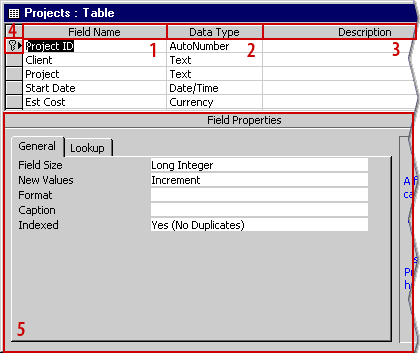
When you open the same table in Design View, Access displays the table definition. This is where you manage field structure and quality rules.
Field list (top pane): Each row represents a field (column) in the table.
Data Type: Determines how Access stores the field (Short Text, Number, Date/Time, Currency, AutoNumber, Yes/No, etc.).
Description: Optional documentation for the field; extremely useful for maintenance and for multi-user databases.
Primary key indicator: A key icon marks the field (or fields) that uniquely identify each record.
Field Properties (bottom pane): Detailed settings that enforce data quality and behavior.
Fields: Each field listed here corresponds to a column you see in Datasheet View.
Data Type: Controls how Access stores values and how they can be sorted, validated, and formatted (for example: Short Text, Date/Time, Currency, AutoNumber).
Description: Documents what the field is for; helpful for long-term maintenance and for handoffs to other users.
Primary key: The key icon marks the primary key field used to uniquely identify each row and support relationships.
Field Properties: Settings such as Field Size, Required, Default Value, Validation Rule, and Input Mask refine the field definition and help prevent bad data.
Why Design View matters in modern Access
In modern Access (including Microsoft 365), Design View is still essential because it is where you:
Prevent bad data at the source by enforcing required fields and validation rules.
Reduce cleanup work later by selecting correct data types (for example, storing ZIP codes as Short Text to preserve leading zeros).
Support forms and reports reliably by ensuring fields behave consistently for sorting, grouping, and calculations.
Prepare for integration if Access is used as a front end to SQL Server or exported to Excel/Power BI, where clean data types and keys matter.
A well-designed table makes every downstream object easier to build, easier to troubleshoot, and easier to maintain.
The next lesson introduces common Access data types and guidance for choosing the correct type for each field.