| Lesson8 | Creating hyperlinks in a table |
| Objective | Enter hyperlinks in a MS Access Table |
Enter Hyperlinks in a Microsoft Access Table
Hyperlinks are useful because they are “actionable” data. Instead of storing a plain text URL that must be copied and pasted, a Hyperlink field lets the user click to open the target immediately (assuming they have the right permissions and the target exists).
What a Hyperlink field can open
When the field data type is set to Hyperlink, Access can store links to common targets such as:
- Web pages (HTTP/HTTPS): opens the link in the user’s default web browser.
- Email addresses (MAILTO): opens the default email client with a new message addressed to that recipient.
- Files or folders: opens a file or folder path. This can be a local path (for example, a file on the workstation) or a network path (for example, a shared folder).
How to enter hyperlink values
You enter hyperlink data much like any other field value: click into the cell in Datasheet view and type the link. The main difference is that once Access recognizes the value as a hyperlink, clicking it will activate the link. If you need to fix a typo, you typically edit rather than “click.”
Editing hyperlinks safely
If you click a hyperlink cell, Access may open the link instead of placing the insertion cursor in the text. Use one of these methods to edit the hyperlink without activating it:
- Right-click the hyperlink field and choose Hyperlink > Edit Hyperlink. This opens the Edit Hyperlink dialog where you can correct and refine the link.
- Press F2 while the field is selected to place the cursor inside the value for in-place editing. This is often faster for small corrections.
The Edit Hyperlink window
The Edit Hyperlink dialog provides structure and reduces mistakes. It allows you to control the link target and the text users see.
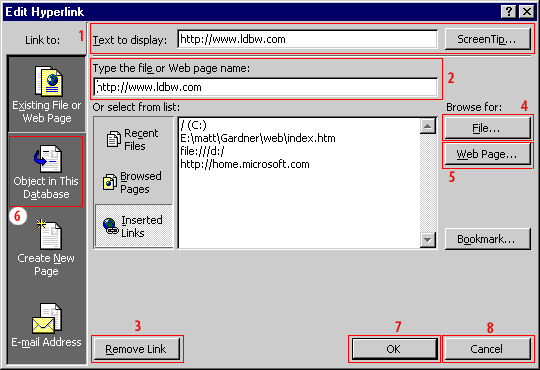
- Text to display: the label users see in the table (it does not have to match the actual address).
- Address: the full URL or file path that Access will open when clicked.
- Remove Link: converts the entry back to non-clickable text.
- Browse File: locate a file or folder target.
- Browse Web: locate or paste a web address.
- Link to database object: create a link to another Access object (for example, a report or form).
- OK: saves changes.
- Cancel: closes without saving.
Modern guidance and best practices
-
Prefer HTTPS for websites. Store full URLs (including
https://) so the browser opens reliably. -
Use network paths carefully. If you link to files/folders on a network share, users must have access rights.
For shared folders, a UNC path (for example,
\\Server\Share\Folder) is more portable than a drive letter mapping. -
Keep “Text to display” human-friendly. For example, display
Client Websitewhile the Address contains the full URL. - Consider storing URLs as Short Text in integration scenarios. If you expect to export to SQL Server or integrate with external tools, storing a URL as Short Text can be simpler. You can still make it clickable in forms and reports using hyperlink formatting.
Next, you will continue working with table editing tasks by moving a field in Datasheet and Design views.
Move a field in Datasheet and Design views.
MS Access Hyperlink Field Form - Exercise
MS Access Hyperlink Field Form - Exercise